How to Find Someone on Hinge (And Verify a Match Before You Meet)

Hinge has no search function — no name lookup, no username directory, no way to browse to a specific person. That is a deliberate product decision, not a feature you have missed. What you can do is influence who appears in your queue, and — more usefully — verify a match you already have before meeting them.
Why there is no search, and why that is intentional
Hinge is built around a curated queue. The algorithm decides who you see, drawing on your stated preferences, your location, your activity and — where accounts are linked — your social graph. There is no directory to browse and no index to query.
This is a safety design as much as a product one. A searchable dating platform is a gift to anyone who wants to locate a specific person: an ex, a stalker, someone who has blocked them. Every major dating app has moved away from open search for exactly this reason.
Which also means that services advertising "Hinge profile search" are not doing what they claim. There is no API for it and no public index to scrape at scale. In practice these tools either return nothing or return unrelated data-broker records with a dating-app label attached.
What you can actually influence
If your goal is that a particular person might see you, or that you might see them, a few things genuinely affect the queue:
Preferences. Age range, distance, and the various filters determine the eligible pool. If someone falls outside your stated range, they will not appear.
Location. The queue is distance-weighted. Being in the same city is a prerequisite for most matches.
Activity. Active accounts are surfaced more. A dormant profile is shown less often to everyone.
Linked accounts. If you have connected Facebook, Hinge may deliberately hide profiles that share connections with you, on the assumption you would rather not be shown people you know. If you are trying to be visible to a wider circle, that link is working against you.
None of this amounts to finding a person. It amounts to slightly improving the odds of an intersection, and it is worth being honest that the odds remain low.
The better question: is this match real?
Most people arriving at this topic do not actually want to find a stranger. They want to know whether the person they are already talking to is genuine — before spending an evening, sharing a phone number, or getting on a train.
That question is answerable, and the methods are quick.
Check the platform's own verification
Hinge offers selfie verification, and a verified badge means the app has matched a live selfie against the profile photos. It is not proof of identity — it does not confirm a name — but it does confirm that the person in the photos is the person operating the account, which defeats most straightforward catfishing.
An unverified profile is not a red flag on its own. An unverified profile that resists every other check is.
Reverse image search the photos
This is the highest-yield check available and it takes under a minute. Save the profile photos and run them through a reverse image search.
What you are looking for: the same images appearing on a stock photo site, on an unrelated social profile under a different name, on a modelling portfolio, or in a scam-reporting forum. Any of those settles the matter immediately.
Run more than one photo. Recycled-photo operations often mix a stolen set with one genuine image, and checking a single picture can miss it.
Ask for a live video call
The single most effective test, and the one that separates real hesitancy from a scripted excuse.
A real person may reasonably be shy about video early on. What is not reasonable is a pattern: broken cameras, bad connections, unusual work schedules, being temporarily abroad — a new obstacle every time, over weeks, while the emotional intensity increases. That combination is close to diagnostic.
Verify the identifiers they have given you
Once a match shares a phone number or an email address, you have something checkable.
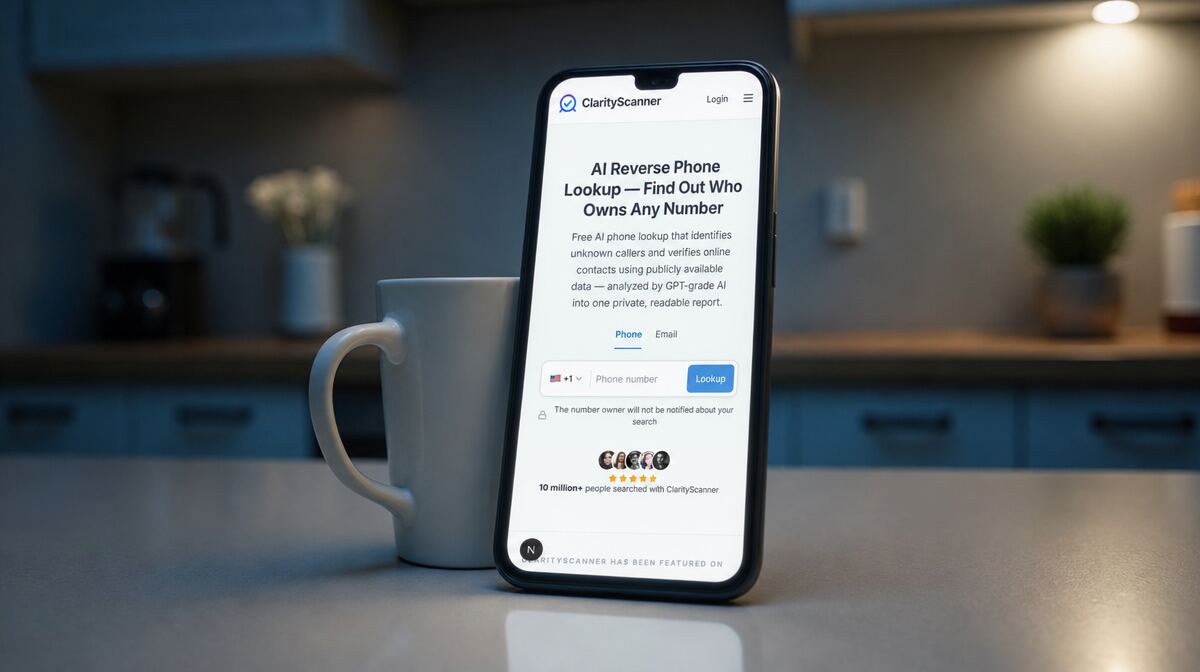
A phone number that resolves to a name matching what they have told you, in a region matching their claimed city, on a normal mobile carrier, with an established history, is corroboration. A number with no history at all, on a VoIP line, in the wrong region, is a mismatch worth taking seriously — see reverse phone lookup for how to read the result.
An email address works the same way, and often better. Finding someone on dating sites by email covers using an address to check whether their story holds together.
Read the profile for effort
Fake profiles are optimised for volume, and it shows. Three photos, all professionally lit, none casual. Prompts answered generically, or in language that does not match how they message. No specific detail about the city they claim to live in. An occupation that conveniently explains being unreachable — offshore engineering, military deployment, international contracting.
Real profiles are messier. They contain bad photos, in-jokes, and specific references to actual places.
| Check | Time | What it catches |
|---|---|---|
| Platform verification badge | Instant | Photo-identity mismatch |
| Reverse image search | 1 minute | Stolen and stock photos |
| Live video call | 10 minutes | Nearly all impersonation |
| Phone number lookup | 1 minute | Disposable numbers, wrong region, false name |
| Email lookup | 1 minute | Fresh addresses with no history |
| Profile effort read | 2 minutes | Volume-produced fake profiles |
The pattern worth memorising
Romance fraud follows a consistent shape, and recognising it early costs nothing.
Contact is warm and attentive immediately. Affection escalates far faster than the actual acquaintance justifies. There is early pressure to move to a private messaging app — which removes the platform's reporting, blocking and moderation. Video calls never quite happen. A backstory explains the distance: working overseas, deployed, on a rig, travelling for a contract.
Then, eventually, money. A customs fee, a medical emergency, a flight home, a business opportunity, an investment platform that has been performing remarkably well.
The money request is the point. Everything before it is groundwork, and the groundwork can run for months. The single most protective rule available is simple: never send money to someone you have not met in person. It requires no judgement about whether a particular story is true.
Before you meet
Video call first. Tell a friend where you are going and who with. Meet somewhere public. Arrange your own transport both ways. Keep the first meeting short and daytime if you can.
None of this is paranoia; it is the same set of habits that makes any first meeting with a stranger unremarkable rather than risky.
And if you cannot find them
If someone has stopped responding, or you suspect they have blocked you, the absence of a search function is not the obstacle — the answer is. Blocking on Hinge removes the profile from your view entirely and permanently, and there is no legitimate way around it.
That is the system working correctly. If you are trying to find someone who has withdrawn contact, the honest position is that the platform has already given you their answer.
Frequently asked questions
Can you search for a specific person on Hinge?
Will Hinge show me someone if we have mutual friends?
How do I know if a Hinge profile is real?
Is it safe to give a match my phone number?
What are the strongest signs of a dating scam on Hinge?
Keep reading
Dating & Relationships
What Apps Do Cheaters Use? What the Lists Get Wrong
Dating & Relationships
Find Someone on Dating Sites by Email: What Actually Works
Privacy & Safety
Unknown Caller: What It Means and How to Find Out Who It Is